
Key Takeaways
- Online and in-person therapy can both provide meaningful, effective psychological support. Neither format is automatically better for everyone.
- Online therapy offers greater convenience, flexibility and geographical choice, particularly for people who find travelling or fitting appointments around everyday life difficult.
- In-person therapy gives the counsellor a fuller view of body language and provides a dedicated, neutral environment away from home.
- A strong therapeutic relationship can develop online as well as face-to-face, although some people naturally feel more connected when sharing the same physical space.
- Online counselling requires suitable technology, a reliable internet connection and somewhere private where you can speak freely.
- In-person counselling may involve greater expense, travelling and more rigid appointment times, while your choice of therapists is usually limited by geography.
- The best choice often comes down to where you feel safest, most comfortable and most able to speak openly. Finding the right therapist may ultimately matter more than whether you meet them through a screen or in a room.
Not very long ago, asking whether you wanted therapy online or in person would have seemed like a strange question.
Counselling traditionally meant travelling to a therapist’s consulting room, sitting down together and talking face-to-face.
Today, the therapy room might just as easily be your living room, home office or bedroom.
That leaves many people wondering whether one experience is somehow better than the other.
Online and in-person therapy can both be effective, and neither is inherently better for everyone.
The right choice depends on your individual needs, privacy, lifestyle, accessibility and whether you feel more comfortable talking to a therapist through a screen or in the same room.
As a counsellor, I think the word comfortable deserves particular attention here.
Therapy asks us to talk about things we may rarely discuss with anybody else.
That might include anxiety, relationships, grief, trauma, childhood experiences, self-esteem or thoughts and emotions we have kept hidden for years.
The environment in which that conversation happens can therefore make a considerable difference.
Some people love the separation created by travelling to a therapist’s consulting room.
Closing the door behind them feels like entering a safe space where the outside world can temporarily wait.
Other clients experience exactly the opposite.
Sitting in an unfamiliar room opposite somebody they have only recently met can initially feel intimidating.
Speaking from the familiarity of home can help them relax and open up more naturally.
Neither response is right or wrong.
Having worked with clients remotely, I have seen how genuine and meaningful a therapeutic relationship can become without two people ever physically occupying the same room.
But I also recognise that online therapy cannot perfectly recreate every element of being face-to-face.
So when comparing online therapy vs in person therapy, I don’t believe we should be looking for an overall winner.
The more useful question is: which environment will help you get the most from therapy?
Article Chapters
What is Virtual Online Therapy?
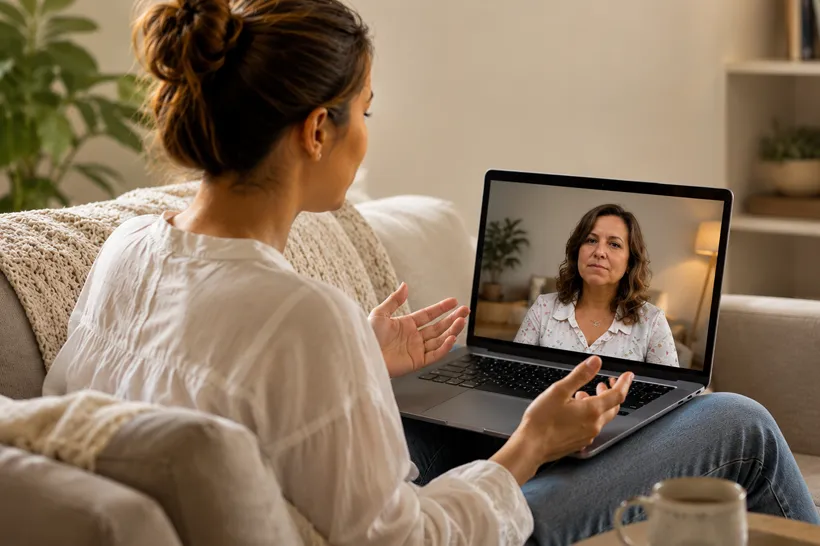
Virtual online therapy is counselling or psychotherapy delivered remotely using digital technology rather than with the client and therapist physically meeting in the same location.
For many people today, that means a private video appointment where therapist and client can see and hear one another in real time.
Depending on the therapist and service, remote support can also include telephone counselling or other forms of communication, although video counselling most closely resembles a traditional face-to-face session.
The underlying purpose of therapy does not change simply because it takes place online.
You still have an agreed appointment.
Your therapist should still explain how the sessions will work, the boundaries of the therapeutic relationship and how your confidentiality and personal information are protected.
You still have dedicated time to explore your emotions, experiences, difficulties and goals.
What changes is the environment surrounding that relationship.
Instead of travelling somewhere specifically for therapy, you create the therapeutic space wherever you happen to be.
For the right person, that can make counselling considerably easier to access.
Pros of Online Therapy
Comfort and Convenience
One of the most obvious benefits of online counselling is being able to attend from somewhere familiar.
I think this advantage is sometimes dismissed as simple convenience when psychologically it can mean considerably more.
Starting therapy can feel daunting.
You are meeting someone new and potentially preparing to discuss deeply personal experiences.
Removing the additional uncertainty of an unfamiliar building, waiting room and consulting room can make those first few sessions feel more manageable.
Some clients feel safer talking from their own sofa with a cup of tea beside them.
Others like being surrounded by familiar belongings or knowing that once a difficult session ends, they do not immediately have to walk through a waiting room or travel home.
For someone who already feels anxious or emotionally vulnerable, familiarity can provide a useful sense of grounding.
Flexible Scheduling
Online counselling can offer greater flexibility because the therapist and client do not need to be in the same geographical location.
This can make sessions easier to arrange around work, family responsibilities and other commitments.
It can also widen the available pool of therapists.
Instead of searching only for somebody who happens to practise within a reasonable travelling distance, you may be able to consider therapists based elsewhere who offer appointments at times that better suit your routine.
This does not mean every online counsellor offers appointments around the clock.
Therapists still have working hours and existing clients.
But removing the need to coordinate an appointment with a journey can make the process considerably easier.
No Need to Travel
Travel can create a surprisingly significant barrier to therapy.
An hour-long counselling session may involve considerably more than an hour of your day once driving, public transport, traffic, parking and walking are taken into account.
For somebody living in a rural location, that journey could be substantial.
For somebody without a car, simply reaching a suitable therapist might involve several buses or trains.
Online counselling removes most of those practical obstacles.
You can finish work, close the door, connect to your appointment and begin.
This can be particularly valuable for people with mobility difficulties or other circumstances that make travelling harder, although online therapy itself is not automatically accessible to everybody.
Requires Less Personal Time
Time is one of the reasons people postpone therapy.
We often imagine the commitment as “one hour a week”, but an in-person appointment can consume a much larger part of the day.
If you need 30 minutes to travel there and another 30 minutes to return, your one-hour session has already become a two-hour commitment.
Add parking, waiting or delays and it becomes longer still.
Online therapy can reduce that additional time considerably.
For people balancing employment, children, caring responsibilities or busy family lives, that difference can determine whether regular counselling is realistically sustainable.
And consistency matters.
A format that you can reliably attend may ultimately be more useful than one that seems preferable in theory but repeatedly clashes with everyday life.
Accessible Virtually Anywhere
One of the biggest changes brought about by online therapy is geographical choice.
Traditionally, choosing a counsellor meant asking who practised near enough for you to reach them regularly.
Online counselling can remove much of that geographical restriction.
This can be particularly useful if you live somewhere with relatively few therapists or are looking for somebody experienced in a particular area.
Instead of being restricted to professionals within a few miles of home, you may have access to a much broader selection.
I personally have clients based in cities and towns in various locations.
Whether you want to find private counselling in Edinburgh, London, Liverpool or Cardiff, or overseas in Italy or another country, a virtual counselling arrangement makes finding a suitable therapist so much easier.
There are still professional, legal and practical considerations around where therapists and clients are located, particularly when working across national borders, so “anywhere” should not be interpreted literally.
But within appropriate professional arrangements, online counselling can significantly widen access.
Confidential
Online therapy should be approached with the same professional commitment to confidentiality as face-to-face counselling.
A responsible therapist should explain how sessions are conducted, how information is handled and any limitations to confidentiality before therapy begins.
There is, however, another side to privacy online that has less to do with the therapist and more to do with your environment.
You need somewhere you can speak freely.
If you live with a partner, parents, children or housemates and worry they can hear through the wall, you may find yourself unconsciously editing what you say.
Wearing headphones can prevent other people hearing your therapist, but it cannot prevent them hearing you.
So online therapy can be highly private from a professional perspective while still requiring you to create sufficient privacy at your end.
For some clients that is easy.
For others, it can become one of the strongest arguments for attending therapy somewhere else.
Lower Cost
Online therapy can sometimes be less expensive, but I would be cautious about treating lower cost as a universal rule.
Individual therapists set their own fees and many charge the same amount whether sessions happen online or face-to-face.
Where online counselling can save money is around the appointment itself.
There may be no fuel, train fare or parking charges.
You may not need additional childcare or as much time away from work.
Therapists working entirely online may also have lower premises costs, which can sometimes be reflected in their fees.
The important point is to compare the total practical cost of accessing therapy rather than assuming the session fee tells the whole story.
Cons of Online Therapy
Therapist Can’t Read Nonverbal Cues
Communication involves far more than words.
As a counsellor, I listen to what somebody tells me, but I am also aware of pauses, changes in tone, facial expressions, posture and other subtle shifts that can add context to what is being discussed.
Video counselling does not remove nonverbal communication altogether.
I can still see a client’s face, hear their voice and notice many emotional responses.
But the screen narrows the view.
I may see someone’s head and shoulders without seeing what is happening with their hands or posture.
Small physical changes can be harder to notice.
Eye contact also works differently through a camera because looking directly at someone’s face on a screen is not quite the same as looking into their eyes in a room.
For many forms of counselling this does not prevent meaningful therapeutic work, but it is a genuine difference.
Client Can’t Fully Assess Therapist
The same limitation works in the opposite direction.
Clients read therapists too.
When you sit in a room with somebody, you take in far more than their words.
You notice their manner, physical presence, movements and the atmosphere they create around you.
A video call provides some of that information but not all of it.
This matters because trust is not built exclusively through conversation.
Sometimes we simply develop a feeling that another person is safe to talk to.
That feeling can certainly develop online, but some people find it easier to assess whether they connect with a therapist when meeting them physically.
Technical Knowledge
Online counselling requires at least a basic level of confidence with technology.
You need a suitable device, the ability to join the chosen video platform and enough understanding to resolve simple problems such as microphone, camera or audio settings.
For somebody who uses video calls every day, this barely warrants consideration.
For somebody uncomfortable with computers or smartphones, it can become an unnecessary source of anxiety before every session.
Therapy already asks enough of us emotionally.
If the technology itself repeatedly causes stress, face-to-face counselling may simply feel easier.
Internet Speed & Buffering
Few things interrupt an emotional conversation quite like hearing:
“Sorry, you froze.”
Poor internet connectivity is one of the unavoidable weaknesses of online therapy.
A brief delay might be mildly irritating during an ordinary conversation.
During counselling, it can be much more disruptive.
Imagine finally finding the courage to say something deeply personal only for the screen to freeze halfway through the sentence or you experience a power cut.
Even minor delays can interrupt the natural rhythm of conversation.
Most sessions conducted over a reliable broadband connection will not suffer serious problems, but technology can fail.
A good online therapist should therefore have an agreed plan for what happens if the connection drops, such as reconnecting or continuing temporarily by telephone.
Lack of Human Connection
This is perhaps the most subjective difference of all.
Some people simply prefer being physically present with another human being.
They find sitting together warmer, more natural and more emotionally connected than communicating through a screen.
That experience is valid.
But I would be very careful about suggesting that online therapy itself lacks human connection.
A strong therapeutic relationship is built through empathy, trust, consistency and the experience of being genuinely understood.
Those qualities are not confined to a physical room.
Research into video psychotherapy has found that meaningful therapeutic alliances can develop remotely too.
In my own experience, clients can share extraordinarily personal experiences online and form deep, trusting therapeutic relationships.
The difference is individual.
If screens make conversations feel distant to you, that matters.
If being at home actually helps you lower your guard and connect more easily, that matters just as much.
What is Face-to-Face In Person Therapy?
Face-to-face therapy is the traditional model most people picture when they think about counselling.
You and your therapist meet physically in the same private space, usually at a counselling practice, clinic or dedicated consulting room, for an agreed period of time.
There are no cameras or screens separating you.
That physical environment creates a clear boundary around the session. You arrive, enter the therapy room, spend time focused on yourself and then leave.
I think that transition is more psychologically valuable for some people than we sometimes acknowledge.
Travelling to therapy can be inconvenient, but the journey can also provide time to prepare beforehand and reflect afterwards. The consulting room becomes somewhere associated specifically with therapeutic work rather than another activity taking place within your home.
For clients whose homes are busy, stressful or lacking privacy, that separation can be enormously valuable.
Pros of In Person Therapy
Nonverbal Cues
Being in the same room gives both therapist and client access to a richer range of nonverbal communication.
A therapist can observe posture, movement, gestures and subtle changes that may be outside the frame during a video call.
This does not mean therapists are secretly analysing every movement or assuming folded arms mean something specific.
Body language is contextual.
But having a fuller picture can sometimes help me notice when a client’s words and emotional response appear to differ.
Somebody may tell me they are “fine”, for example, while their entire physical presence suggests that something more complicated is happening.
Those moments can gently open conversations that might otherwise remain unexplored.
Form Deeper Connections
For some clients, physical presence helps the therapeutic relationship develop more naturally.
There is a quality to sitting quietly with another person that technology cannot completely reproduce.
Silence can feel different.
Eye contact is direct rather than mediated through a camera.
Even the sense of sharing the same physical environment can make difficult emotional moments feel less solitary.
That does not mean in-person relationships are automatically deeper than online ones.
A poor therapeutic match does not become a good one simply because two people share a room.
But if physical presence is important to the way you connect with people, face-to-face counselling may help you feel more comfortable building trust.
Wider Treatment Modalities
Talking therapies can work extremely well online, but not every therapeutic intervention translates equally easily to a screen.
Some approaches involve physical materials, movement, creative activities or other forms of interaction that benefit from therapist and client sharing the same space.
The suitability of remote work can also depend on the person’s needs, circumstances and level of risk.
This is why I would avoid making sweeping claims that online therapy can replace every form of face-to-face psychological support.
It cannot.
Equally, that does not diminish the many situations in which remote counselling works extremely well.
A suitably qualified therapist should consider whether the way they propose working is appropriate for the individual client rather than simply assuming their preferred delivery method will suit everyone.
Safe Neutral Space for Clients
One of the greatest advantages of in-person therapy is something online counselling cannot easily provide: somewhere else to go.
Home is not a safe or relaxing environment for everybody.
Perhaps you live with the person you need to talk about.
Maybe you have children constantly moving around the house.
Perhaps family members are intrusive, walls are thin, or you simply cannot relax while wondering whether somebody is listening outside the door.
A counselling room provides neutral territory.
For the duration of the session, you are away from your everyday environment and somewhere designed specifically for private conversation.
That physical separation can also create emotional separation.
Some clients tell me they prefer difficult feelings to remain within the therapy room rather than opening deeply personal subjects in the same bedroom or living room where they later need to sleep, work or spend time with family.
For those people, travelling to therapy is not an inconvenience.
It is part of what makes therapy feel safe.
Cons of In Person Therapy
Lack of Choice
Perhaps the biggest practical limitation of traditional counselling is geography.
You need to be able to reach your therapist.
If you live in a large town or city, you may have plenty of choice. If you live in a rural area, suitable therapists may be considerably further away.
The problem becomes more noticeable when you are seeking someone with particular experience.
The therapist who seems best suited to your needs may practise 50 miles away.
Online counselling can substantially widen that choice, whereas face-to-face work inevitably asks you to balance suitability against travelling distance.
Accessibility
Getting to a counselling room is easy to take for granted until travelling becomes difficult.
Mobility problems, disability, health conditions, lack of transport and inaccessible premises can all create barriers.
Responsible counselling services should make reasonable efforts to improve accessibility, but not every building or location will meet every client’s needs.
Online therapy can remove some of these obstacles, although it can introduce different accessibility challenges of its own, including technology, connectivity or difficulties using digital platforms.
The important question is therefore not whether one format is universally “more accessible”.
It is: accessible for whom?
Inflexible Scheduling
Face-to-face appointments involve two people needing to be available in one specific place at one specific time.
That inevitably reduces flexibility.
A therapist may only use a particular consulting room on certain days.
Popular evening appointments can fill quickly.
Travelling during rush hour might turn an otherwise convenient session into a logistical headache.
People with irregular working patterns, long commutes or changing family commitments may therefore find online appointments easier to sustain.
Again, this is not true of every therapist.
Some face-to-face practitioners offer extremely flexible schedules.
But the physical requirement to meet in one location inevitably adds another constraint.
Demands More Personal Time
An hour of face-to-face therapy rarely requires only an hour.
You need to get there and back.
Depending on where you live, that might turn a 50-minute counselling appointment into two or even three hours away from home or work.
For someone attending weekly therapy, that commitment adds up.
There can, however, be another side to this disadvantage.
The journey home sometimes gives clients valuable time to decompress and think about what has emerged during the session.
With online counselling, it is possible to close the laptop after an emotionally intense conversation and immediately find yourself making dinner, answering work emails or dealing with family life.
Efficiency is useful, but sometimes a little breathing space is useful too.
Higher Costs
Face-to-face counselling can carry additional costs beyond the therapist’s fee.
There may be petrol, public transport or parking to pay for.
Parents might need childcare.
Some people may need additional time away from work.
Therapists providing in-person counselling also usually have the expense of maintaining or renting suitable premises, although this does not necessarily mean they will charge more than an online therapist.
As with online counselling, prices vary considerably between practitioners and services.
So rather than assuming face-to-face therapy will always be more expensive, I would consider the complete cost of attending regularly.
A slightly cheaper appointment located an hour away may ultimately cost more in both money and time than it initially appears.
Final Thoughts
So, when comparing virtual online therapy vs in person therapy, which is best?
I don’t believe there is a responsible way to give everybody the same answer.
If you value convenience, have limited time, struggle to travel, live somewhere with relatively few therapists or simply feel more comfortable talking from home, online counselling may suit you extremely well.
If you value physical presence, want a clear separation between therapy and home, lack somewhere private to talk, or prefer the fuller human interaction of sharing a room, face-to-face counselling may be the better choice.
There is also nothing wrong with trying one format and discovering that you prefer the other.
Therapy is personal.
What helps one client feel safe may make another feel uncomfortable.
One person may find a screen creates distance, while somebody else may find that small amount of distance makes it easier to talk.
One client may resent spending an hour travelling to an appointment, while another values that journey as time set aside entirely for themselves.
Neither is doing therapy incorrectly.
If I were choosing between the two, I would think less about which format is supposedly “best” and more about the conditions I need in order to speak honestly.
Do I have genuine privacy at home?
Do I feel comfortable using video technology?
Is travelling difficult?
Do I need the separation of a dedicated counselling room?
Would I rather choose from therapists further afield?
And, perhaps most importantly, where do I feel most able to develop trust with the person sitting opposite me?
Because ultimately, therapy is not defined by the room in which it happens.
Whether that person is sitting a few feet away or appearing on a screen, what matters is that you feel heard, respected, safe enough to be honest and confident that the therapist has the appropriate skills and experience to help you.
For many people, the choice between online and in-person counselling will come down to practical circumstances and personal preference.
But finding the right therapist may matter far more than deciding whether you meet them through a doorway or through a screen.